Boiler Repair in Rego Park, Queens
Cold radiators during winter freezes, low system water pressure, and emergency burner lockouts demand fast, technical diagnosis. We repair steam boilers and hydronic heating systems across Rego Park multi-family properties and residential homes.
Restoring Reliable Heating in Rego Park, Queens
When dealing with boiler repair Rego Park Queens property owners face systems operating under intense seasonal stress. Rego Park buildings along Queens Boulevard, 63rd Road, and Booth Street rely on heavy-duty cast-iron steam boilers or closed-loop hydronic circulating systems to provide vital winter warmth.
During freezing weather, a boiler issue is far more than an inconvenience. A sudden no heat boiler repair Rego Park Queens call often stems from low-water cutoff lockouts, electronic flame sensor failures, seized circulator pumps, or relief valves discharging under over-pressure conditions.
Importantly, heating problems can masquerade as plumbing leaks. A mystery drop in system pressure is often caused by an underground heating return pipe leak rather than a boiler mechanical breakdown. Whether you need specialized steam boiler repair Rego Park Queens, troubleshooting for a hot water boiler repair Rego Park Queens, or emergency assistance for a boiler not working Rego Park Queens situation, our licensed technicians restore safe operation.
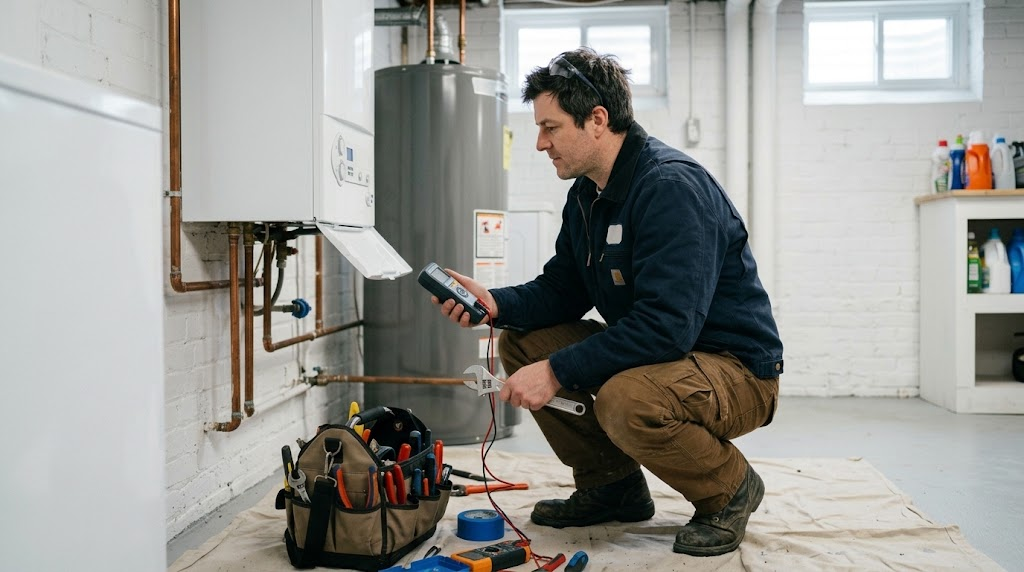
Evaluating low-water cutoffs, pressure-relief valves, gas manifolds, and electronic ignition controls in Rego Park boiler rooms.
Steam Versus Hydronic Heating Differences
Understanding the distinction between steam and hydronic heating determines how diagnostics and safety repairs proceed:
Steam Heating Systems
Common in classic pre-war co-ops and brownstones, steam boilers boil water into vapor that rises under very low pressure (0.5 to 2 PSI) into cast-iron radiators.
Common steam boiler issues include surging water in the sight glass, defective automatic water feeders, clogged low-water cutoff float chambers, and banging pipes caused by trapped condensate.
Hydronic (Hot-Water) Systems
Frequently found in post-war residential buildings and two-family homes, hydronic boilers circulate hot water at 12 to 20 PSI through baseboards and fan-coil loops.
Key diagnostic concerns include seized circulator pumps, waterlogged expansion tanks, air pockets blocking circulation, and leaking pressure-reducing autofill valves.
Symptoms Requiring Urgent Boiler Service
Boiler mechanical problems worsen rapidly in freezing temperatures. Call for service if you experience:
Burner Lockout & No Heat
If the gas burner attempts to fire but clicks off after several seconds, dirty flame rectification sensors, failed ignition modules, or draft inducer pressure switches are triggering safety lockouts.
Chronic Pressure Loss
A boiler that repeatedly loses water pressure requires immediate investigation. If the vessel itself is not visibly leaking, an underground heating loop or concealed riser pipe may be losing water.
Relief Valve Discharging
Hot water spewing from the 30 PSI (hydronic) or 15 PSI (steam) safety relief valve pipe onto the basement floor indicates dangerous over-pressurization or a compromised expansion vessel.
The Boiler Diagnostic Protocol
Our heating technicians follow a rigorous systematic procedure to diagnose boiler failures:
Safety Interlocks
We test low-water cutoffs, spill switches, high-limit aquastats, and roll-out sensors to ensure vital safety mechanisms operate properly.
Combustion Check
We test manifold gas pressure, verify flame rectification millivoltage, inspect burner ribbons, and check chimney draft.
Hydraulic Loop
We inspect expansion tanks for diaphragm failure, test circulator pump amperage, and check autofill pressure valves.
Leak Testing
If pressure drops persist, we isolate the boiler vessel from building heating loops to differentiate between equipment and pipe leaks.
Connected Heating & Plumbing Services
Boilers interact closely with water heating, gas piping, and concealed leak detection across Rego Park:
Water Heater Repair
Troubleshooting standalone domestic water heaters and indirect storage tanks heated by central residential boilers.
Water Heater HelpGas Line Repair & Inspection
Verifying gas train pressure, shutoff cock integrity, and code-compliant black iron piping delivering fuel to your boiler.
Gas Line TestingLeak Detection Services
Acoustic and thermal detection to locate concealed leaks in buried steam return lines and radiant heating floor loops.
Explore Leak DetectionFrequently Asked Questions About Boilers
Technical answers regarding steam and hydronic boiler repairs, pressure loss, and safety controls in Rego Park.
Steam boilers boil water to create vapor that travels under low pressure (0.5 to 2 PSI) to radiators through large-diameter iron piping, relying on sight glass levels and low-water cutoffs. Hydronic boilers circulate hot pressurized water (typically 12 to 20 PSI at 180°F) in a closed loop using electric circulator pumps and expansion tanks.
Frequent pressure drops indicate a concealed leak within the heating distribution loop—such as a weeping buried return line, leaking radiator valve, or failing automatic water feeder. Constant fresh makeup water introduces oxygen and minerals that accelerate internal cast-iron heat exchanger scaling.
The pressure relief valve opens to prevent catastrophic over-pressurization. Discharges are typically caused by a waterlogged expansion tank in hydronic systems, a defective pressure-reducing fill valve, or excessive pressure build-up from an over-firing burner.
The low-water cutoff (LWCO) is an essential safety control that immediately interrupts electrical power to the gas burner if the water level inside the boiler vessel drops below safe operating limits, preventing dry-fire metal cracking and explosion hazards.
Experiencing Boiler or Heating Failure in Rego Park?
Do not wait until winter freezing threatens building pipes. Speak directly with a licensed heating technician for immediate assistance.
Call (315) 202-8009